
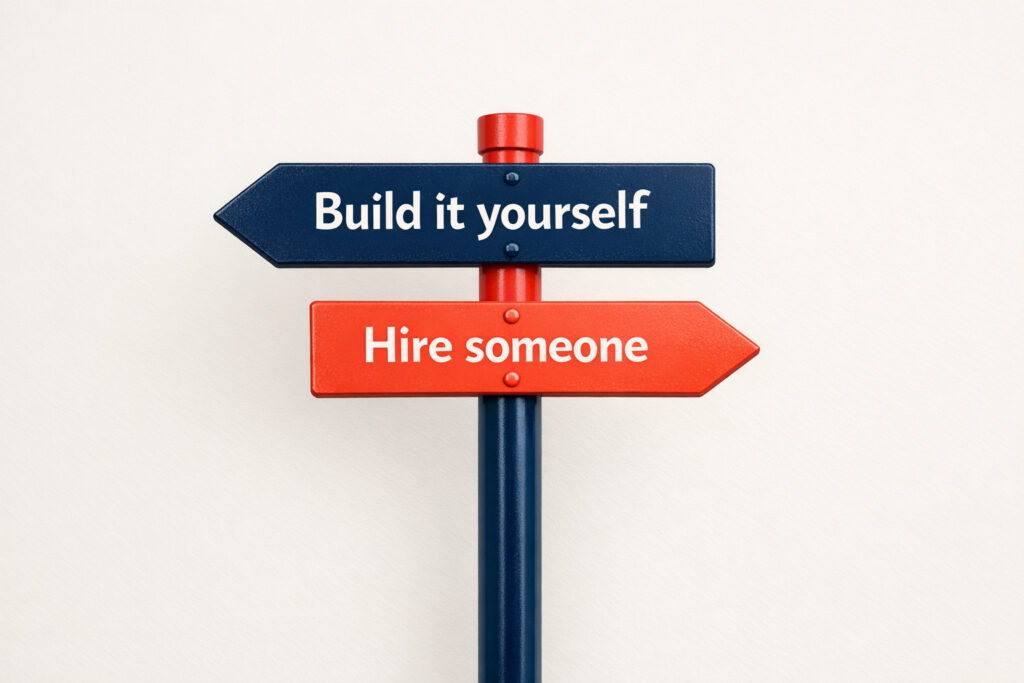
I should put my bias on the table before I say a word: I build websites for a living. So when I tell you whether to build your own site or hire someone, you'd be right to wonder if the answer is always going to be "hire someone (preferably me)."
It isn't. And I'd rather be straight with you, because a client who should have built their own simple site — but got talked into paying me instead — is an unhappy client who feels ripped off, and that's bad for everyone. Some businesses absolutely should DIY their website. Some absolutely shouldn't. The trick is knowing which one you are, so here's the honest version of that decision, bias and all.
The case for doing it yourself
Let's start here, because the DIY option has gotten genuinely good and a lot of people dismiss it too fast.
The modern website builders — Squarespace, Wix, WordPress with a decent template, Shopify for shops — are far more capable than they were even a few years ago. You can build a clean, professional-looking site yourself, with no code, that loads fine and works on phones. For a real chunk of businesses, that's not a compromise. That's genuinely all you need.
DIY makes the most sense when a few things are true:
Your budget is genuinely tight. If you're just starting out and every dollar matters, spending it on inventory, tools, or actually getting customers usually beats spending it on a website. A clean DIY site now beats a perfect custom site you can't afford for another year.
Your needs are simple. A few pages — who you are, what you do, how to reach you, maybe a gallery or a booking link. If that's the whole job, a template handles it well, and paying someone to do something a builder does for you is hard to justify.
You're testing an idea. If you're not even sure this business is the thing yet, do not pour money into a custom site. Throw up a simple DIY version, see if the idea has legs, and upgrade once you know it's real. Spending big on a site for a business you might abandon in four months is the expensive mistake.
You actually enjoy it, or have the time. Some people like this stuff — the tinkering, the fiddling with layouts. If that's you and you've got the hours, DIY can be genuinely satisfying and you'll learn things about your own business in the process.
If most of those describe you, my honest advice is to build it yourself. Don't let anyone — me included — talk you out of the option that fits your situation.
The costs of DIY that nobody mentions
Here's the part the website-builder ads conveniently skip: "free" and "cheap" are about the money, and money is rarely the real cost of DIY. The real costs are quieter.
Your time. This is the big one, and it's almost always underestimated. "It'll take a weekend" turns into three weekends, then a month of evenings, because you're learning the tool and writing the content and making a hundred small design decisions you've never had to make before. That's time you're not spending running your actual business — and your time has a value, even when no invoice reflects it.
The learning curve and the rabbit holes. You'll hit walls. Why won't this image line up? Why does it look broken on mobile? How do I connect a domain? Each one is a search, a forum thread, a frustrating hour. None of it is impossible — but it adds up, and it's deeply unsatisfying when you'd rather be doing the thing you're actually good at.
The "good enough but not quite right" ceiling. This is the subtle one. DIY sites often get to about 80% — they look okay, they function — but that last 20%, the bit that makes a site feel genuinely sharp and intentional, is hard to reach without an eye for it. You can sense something's a little off but can't name it. Most visitors can sense it too, even if they can't name it either.
The sameness. Templates are popular for a reason, which means a lot of other businesses are using the same ones. Your site can end up looking like every other business that picked that theme — fine, but forgettable, and not distinctly you.
Decision fatigue. Every font, colour, layout, and word is now your call, and if design isn't your world, that's a hundred small decisions you're not equipped to make confidently. It's exhausting in a way people don't expect.
The maintenance lands on you forever. Once it's built, you're the one keeping it updated, secure, and backed up. The plugin that breaks, the security update, the form that quietly stops working — that's all yours now, indefinitely.
None of this means don't DIY. It means go in with your eyes open about what "free" actually costs.
And what about AI website builders?
Worth addressing, because it's the newest DIY option and the ads make it sound like magic. The "describe your business and we'll build your site" tools have gotten genuinely useful — they'll spin up a starting point in minutes, which is great for getting unstuck on a blank page.
But the same honest caveats apply, just faster. AI gets you to that 80% even quicker — and then you're still standing at the same ceiling, making the same judgment calls about what's actually right for your business, which the AI can't make for you because it doesn't know your customers or what makes you different. It also tends to produce that same templated sameness, because everyone's describing their business to the same model and getting variations on the same answer. And you're still the one maintaining it afterward.
So treat AI builders as a faster on-ramp to DIY, not a replacement for the thinking. They speed up the production; they don't make the decisions. The judgment is still the job — which, conveniently, is the whole point of this post.
The case for hiring someone
Now the other direction — and I'll try to be as honest about when it's not worth it as when it is.
Hiring makes sense when:
Your website is a real revenue channel. If customers genuinely find you, judge you, and buy from you through your site — if it's not a brochure but an actual part of how you make money — then it needs to perform, and "good enough" starts costing you real money in lost customers. At that point, paying for a site that converts well pays for itself.
Your time is worth more elsewhere. If you're a therapist, a tradesperson, a consultant — someone whose hours are valuable and bookable — then spending forty of those hours wrestling with a website builder is a terrible trade. You'd earn more in your actual work in that time than the site costs, and you'd get a better site. Hiring isn't an expense there; it's buying your time back.
You need it to actually look like you, not like a template. If standing out matters in your market — if "forgettable but fine" isn't good enough — that's where a person with an eye earns their fee. The difference between a template and a considered design is exactly the 20% DIY struggles to reach.
You need it to do something specific. Custom functionality, real integrations, a particular booking flow, e-commerce that has to work properly — once you're past what a template offers out of the box, DIY gets painful fast and hiring gets sensible.
You don't want to become a part-time webmaster. Some people just want it handled — built right, kept running, someone to call when it breaks — so they never have to think about it again. That peace of mind is a legitimate thing to pay for.
But — and here's me arguing against my own interest — hiring is not worth it if your needs are genuinely simple, your budget is genuinely tight, and you're not even sure the business is the thing yet. In that situation, paying someone is paying for more than you need. Don't.
The middle path most people miss
It's not actually a binary, and the hybrid options are often the smartest move.
DIY, then hire someone to polish. Build the bulk yourself to save money, then pay a professional for a few hours to fix the rough edges — the spacing, the mobile issues, the part that feels off but you can't fix. You get most of the savings and most of the polish.
Hire for the hard part, DIY the rest. Pay someone to set up the foundation, the design, the structure, and the tricky bits — then take over the easy ongoing updates yourself. You're paying for the expertise where it matters and saving on the routine stuff.
Hire for strategy, build the execution. Sometimes the most valuable thing isn't the building — it's someone telling you what your site should say and how it should be structured. Get that direction, then execute it yourself in a builder.
The point: "DIY or hire" isn't the only question. "What's the smartest split?" is often the better one.
How to actually decide
Strip away all of it and the decision comes down to a few honest questions you can answer in five minutes:
How much is your time genuinely worth, and how much of it do you have? If your hours are valuable and scarce, that pushes hard toward hiring. If you've got time and not much money, that pushes toward DIY.
Is your website core to how you make money, or is it a digital business card? Revenue channel → lean toward hiring it done well. Simple presence → DIY is probably fine.
Do you enjoy this, or dread it? If the idea of building it sounds kind of fun, DIY might genuinely suit you. If it fills you with dread, that dread is information — it means it'll drag, it'll stall, and it might end up the site that's perpetually 80% finished.
Can you live with "good enough"? Be honest. For some businesses, good enough is completely fine. For others, the look is part of the product, and good enough isn't.
Will you actually maintain it? If the honest answer is "probably not," factor in that a DIY site you never update can become a liability — slow, insecure, out of date.
There's no universally right answer. There's only the right answer for your situation, and those questions get you to it faster than any blog post's blanket advice.
The two traps to avoid
Whichever way you lean, there's a failure mode to dodge.
The DIY trap is the site that's perpetually almost-done. You started it, got 80% there, hit a wall, got busy, and now there's a half-built site that's been "nearly ready to launch" for eight months while it quietly does nothing for you. If you're going to DIY, commit to finishing — even imperfectly — because a live, slightly-rough site beats a perfect one that never ships.
The hiring trap is paying for more than you need, or hiring badly. Don't get talked into a $6,000 custom build when a $1,500 starter or a good DIY would've served you. And if you do hire, hire someone who'll be honest about what you actually need — including, sometimes, telling you that you don't need them.
The bottom line
DIY isn't the cheap-and-bad option, and hiring isn't the fancy-and-unnecessary one. They're two reasonable answers to the same question, and which is right depends entirely on your budget, your time, how central the site is to your business, and whether you'll enjoy the process or resent it.
If your needs are simple, your money's tight, and you've got the time and the interest — build it yourself, and don't feel bad about it. If your site earns its keep, your time is better spent elsewhere, and you want it to actually stand out and stay handled — hiring is buying back your time and getting a better result. And for a lot of people, some smart blend of the two is the real answer.
The worst choice isn't DIY or hiring. It's spending money you didn't need to, or spending months not finishing something that should've taken a weekend. Avoid those two, and either path leads somewhere good.
For what it's worth: if you read all this and DIY clearly fits your situation, genuinely — go do it. And if you're not sure which way to go, that's a conversation I'm happy to have honestly, including telling you when hiring me isn't worth it. Either way, I'd rather you make the right call than the expensive one.